
Why Common Sense — and Mars Rovers — Prove Light Isn’t Instant
You don’t need to be an astrophysicist to see the flaw. Sometimes, all it takes is common sense.
Discussions about creationism often drown in technical jargon — relativity, cosmology, redshifts, synchrony conventions. Many readers assume they’re not qualified to follow along. Some simply do not wish to engage in highly detailed discussions and choose to trust someone, with whom they already agree.
But sometimes, what’s needed isn’t math. It’s common sense — grounded in what we already know about how light and communication work. That’s the approach I want to take in this post.
Author’s note: I usually write in Swedish, but this time I wanted to make an argument accessible to an international audience. Some of the phrasing below was produced or refined with the help of ChatGPT, but the idea and reasoning are my own.
It is also unusual since some parts of the text have been written by ChatGPT. But the argument is mine. The idea is mine. The instructions to ChatGPT are from me. And I edited the text afterwards. Before we got to an article there also was a lot of back and forth between me and the bot, where I gave it further instructions. There are many ways to use AI while writing. I am experimenting.
I will look into what is known as the Distant Starlight Problem. If the light and radio waves from stars and other objects in the universe have traveled millions and billions of years to reach us on earth, is that not an argument for an old universe? Today, I will refute one explanation from the Young Earth Creationist (YEC) crowd.
They have basically given 5 different answers:
- The Bible says it can not be and whatever we find in nature that seems contradictory must be subject to what the Bible says, even if we cannot explain it yet.
- God has created the universe with an appearance of being old even though it is not. Light was created while being on the way to earth. This was the position in the book that started the modern Young Earth Creationism (YEC) movement, The Genesis Flood: The Biblical Record and its Scientific Implications (1961) by John C. Whitcomb and Henry M. Morris.
- The speed of light used to be much higher than it is today. This was the idea that Barry Setterfield proposed in the article ”The Velocity of Light and the Age of the Universe, Part 1,” Ex Nihilo, vol. 4, no. 1, 1981. The hypothesis is called c-decay, since the constant for the speed of light is c. In Sweden, our most well-known YEC leader, Mats Molén still defends this idea, but it has basically been abandoned by every major YEC organization.
- The earth is young, but the universe is old. That is the foundation of the attempt by Russel Humphreys popularized in his book Starlight and Time (1994). According to this model our earth is situated close to a massive gravitational white hole causing time dilation. Time moves faster in the rest of the universe, much faster than on earth. Light from distant galaxies has thus travelled to us for billions of years. It seems old and is old.
- However, even though Ken Hamm wrote the foreword to the Starlight and Time, his organization, Answers in Genesis (AiG), have abandoned it in favor of Jason Lisle’s “Anisotropic Synchrony Convention” (ASC). Lisle published this idea in Answers Research Journal as “Anisotropic Synchrony Convention — A Solution to the Distant Starlight Problem.” He later elaborated on it in his book The Physics of Einstein (2012).
(Göran Schmidt used time dilation when I confronted him with an example of observations in the cosmos that are problematic for all three models that attempt to be scientific (3, 4 and 5).[1] His answer fails spectacularly. However, the format did not allow me to refute it and I have not got around to doing so on the web either. I have a lot of unfinished writing to do!)
The task at hand
I will explain and refute ASC below. What set me on this path right now was a post by AiG on their Facebook page:
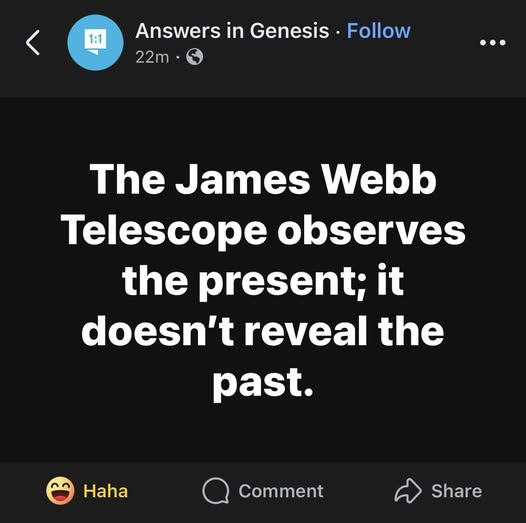
🌌 Jason Lisle’s Idea in a Nutshell
Jason Lisle, an astrophysicist affiliated with Answers in Genesis, has long argued that the universe can be only a few thousand years old — even though we see light from galaxies billions of light-years away.
His proposed fix is what he calls the Anisotropic Synchrony Convention (ASC).
In short, Lisle says:
Light could travel instantly toward Earth but more slowly away from it.
This, he claims, doesn’t violate Einstein’s theory of relativity because the average round-trip speed of light remains constant. It’s a clever bit of mathematical wordplay — but it doesn’t survive contact with reality.
🚀 1. The Mars Rover Test
When NASA talks to its rovers on Mars, the engineers always deal with a delay — anywhere from 4 to 24 minutes, depending on how far apart Earth and Mars are at the time.
They send a command. The rover receives it, processes it, and replies. Every single step of this exchange happens with a predictable delay. Each leg of the exchange — Earth to Mars and Mars to Earth — is one way.
If Lisle were right — if light was truly instantaneous toward Earth — the data from the rovers would arrive the very moment it was sent. But never does. It never has.
This isn’t abstract physics. It’s practical, day-to-day engineering. The entire interplanetary communication system depends on the fact that light speed is the same in every direction. We already observe that symmetry millions of times a day.
We do not measure the one-way speed of light, technically speaking, but we get a general idea of how it works.

💡 2. The Photon’s “Ignorance”
Lisle’s idea also implies that photons somehow “know” whether they’re traveling toward or away from Earth. But photons aren’t conscious little messengers. (Scientifically speaking, they have no way of accessing any information about which way they travel.)
Light is produced whenever an electron jumps between energy levels in an atom. When light hits a mirror, it doesn’t “bounce back” as the same photon; the atoms in the mirror absorb incoming photons and then emit new photons. Nothing gives photons directional awareness.
Each photon that’s ever existed has only one journey — the first and last of its kind. It doesn’t have a built-in GPS that says “I’m on my return leg now, time to slow down.”
From the perspective of the photon, every trip is the first and only trip. So there is no physical basis for the idea of direction-dependent light speed. It’s pure fiction.
🕰️ 3. Redefining Time Isn’t a Solution
In practice, Lisle’s proposal doesn’t change physics — it redefines time so that starlight appears instantaneously. That’s not a model of the universe — it’s a model of words..
If you redefine simultaneity to make every event happen “now,” of course there’s no delay — but that makes astronomy, physics, and even GPS navigation meaningless.
A model that can’t make testable predictions isn’t science. It’s apologetics dressed in equations. Bad apologetics. (I do not mind doing apologetics per se!)
Put it another way: What problem does Lisle try to solve. Have we made any kind of observations that require a fundamental paradigm shift in our understanding of the speed of light? We have not! The only problem is that Lisle is stuck in a flawed rigid hermeneutic of the texts in the Bible.
This has also been noted by other YEC’s. Danny Faulkners has written in Answers Research Journal that ASC “solves nothing that needed solving” and it Is not observable.[2] Faulkner instead proposes the miraculous as an explanation. However, appealing to the miraculous is not something that YECs like to do.
They want their creationism to be counted as a scientific endeavor and be taught in schools and universities. Therefore, critique like Faulkner’s fall on deaf ears.
The leaders of AiG know that their preferred answer to the distant starlight problem is bad. But as the saying goes, weak arguments, shout louder!
🔭 Summary and conclusion: Common Sense and the Cosmos
If light truly reached Earth the moment it was emitted, we’d see everything in the universe in real time — every supernova, every collision, every flare-up in a distant galaxy.
Instead, we see things as they were, not as they are. That’s why astronomy is a window into the past. It’s not because scientists are conspiring against Genesis — it’s because the universe behaves consistently.
Jason Lisle’s “solution” fails both scientifically and logically. It requires light to have selective intelligence (carry information) and denies the most basic observations we make every day.
Common sense says: if light from Mars takes minutes, it doesn’t arrive instantly from Andromeda. Reality, it turns out, is not optional.
📚 Further Reading
- Jason Lisle, Anisotropic Synchrony Convention — A Solution to the Distant Starlight Problem, Answers Research Journal (2010)
- Danny Faulkner, Critique of the Anisotropic Synchrony Convention Model, Answers Research Journal (2017)
- Ethan Siegel, “No, Jason Lisle, You Haven’t Solved the Distant Starlight Problem,” Forbes (2017)
- Jeff Zweerink, Reasons to Believe (2019), “A Relativistic Critique of the ASC Model”
P.S. Do you recognize AI?
There are four kinds of sentences in this post:
- Written by me and kept after review by ChatGPT.
- Written by me and refined by feeback by ChatGPT.
- Written by ChatGPT and refined by me.
- Written by ChatGPT and kept after my review.
Can you pick an example of one of each kind? Write your guess in the comments below.
[1] Lars Gunther, “Gunthers Kritik Av Schmidt,” in Fyra Kristna Diskuterar Skapelse Och Evolution, by Göran Schmidt et al., ed. Mats Selander (Stockholm: Apologia, 2020), 48–54.
[2] Danny Faulkner, “Critique of the Anisotropic Synchrony Convention Model,” Answers Research Journal, 2017; Danny Faulkner, “A Proposal for a New Solution to the Light Travel Time Problem,” Answers Research Journal, 2013.